Daniel Roseberry’s latest collection blurs the line between spectacle and sophistication, reviving the spirit of Elsa with a sensual, modern pulse.

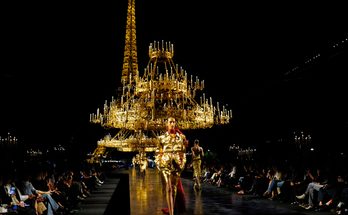
When the lights dimmed inside the Centre Pompidou, the audience fell into a hush that was equal parts reverence and anticipation. Few designers today can command a room quite like Daniel Roseberry. His Spring/Summer 2026 collection for Schiaparelli, aptly titled “Dancer in the Dark,” didn’t just invite the crowd to look—it challenged them to see. What unfolded on that illuminated black runway was a surreal, seductive balancing act that only Roseberry could orchestrate: part haute couture fantasy, part psychological study in power, vulnerability, and allure.
Under Roseberry’s direction, Schiaparelli has evolved into one of fashion’s most fascinating houses—a laboratory where nostalgia and provocation coexist. Since his arrival, he has turned the codes of Elsa Schiaparelli’s surrealism into a living language. He doesn’t quote her; he converses with her. In “Dancer in the Dark,” this dialogue reached a new crescendo. The collection pulsed with movement, mystery, and that signature Schiaparelli “va-va-voom” that makes even the most rigid silhouette seem alive.

From the first look—a sculpted black sheath illuminated by chalk-like white scribbles that traced the contours of the body—it was clear that this season was about the play between exposure and concealment. Was it a nod to burlesque, that Parisian art of suggestion? Or a metaphor for creation itself, for the artist sketching light onto darkness? The ambiguity felt intentional, and deeply satisfying.
Roseberry’s genius lies in his contradictions. He pairs excess with restraint, intellect with instinct. A blouse might appear to be paper, scrunched and fragile, yet its construction is anything but. Elsewhere, gold paintbrushes draped over a two-piece set brought literal weight to the idea of creative labor, while lacquered eggshell hats—a reimagining of Elsa’s eccentric millinery—added sculptural precision to fluid looks.
And then came the contrasts that only Roseberry can pull off. One moment, model Alex Consani glided across the floor in what looked like a whisper of fabric—black wisps suspended in motion, tethered by a single gold string of glowing stones. The next, Kendall Jenner commanded the runway in a daringly bare ensemble: a lace thong and tufts of black ponyhair, her body transformed into a living artwork. It was audacious, yes, but never vulgar. Roseberry’s provocation is always anchored in purpose.


Courtesy of Schiaparelli
The collection’s title suggested darkness, but its true power came from illumination—both literal and metaphorical. Metallic threads shimmered like moonlight on satin. Sculpted gold fingers clutched handbags in surreal gestures, echoing the house’s love of the uncanny. A series of ethereal, see-through dresses played with transparency in a way that felt more emotional than erotic.
Roseberry understands that sensuality isn’t about skin—it’s about tension. His women don’t simply wear clothes; they perform in them. They move through desire, doubt, and defiance, every gesture choreographed yet seemingly spontaneous. “Dancer in the Dark” wasn’t just a title—it was a state of mind.
Kendall Jenner’s presence in the cast underscored Roseberry’s savvy embrace of celebrity culture, while Kylie Jenner and Rosalía—ELLE’s September cover star—cheered her from the front row. But beyond the spectacle, Roseberry’s runway felt deeply personal. There’s a sense that he’s not just dressing women; he’s studying them. Each piece, no matter how theatrical, spoke to a desire for authenticity beneath the artifice.
In one standout look, a high-neck gown appeared as if it were peeling away from itself—faux-distressed edges revealing shimmering gold beneath. It was a quiet metaphor for transformation, for beauty emerging through imperfection. Even the most abstract designs carried this human pulse.

For all its surreal references, the Schiaparelli woman remains grounded in modernity. Roseberry’s ready-to-wear often verges on demi-couture—impossibly detailed, yet wearable in the real world. He has found the sweet spot between craft and charisma, bringing sparkle back to a house that once defined the avant-garde.
There’s always a duality at play in his work: the tension between weight and lightness, art and anatomy, fantasy and function. When that balance clicks—as it did tonight—the result is electric. Roseberry doesn’t just show clothes; he stages experiences.
A century after Elsa Schiaparelli turned fashion into surrealist theatre, Roseberry continues her revolution with modern tools. His women aren’t muses frozen in time—they’re in motion, caught between dreams and reality.

As the show closed and the room erupted in applause, one thing was clear: “Dancer in the Dark” wasn’t about darkness at all. It was about illumination—the kind that comes when an artist dares to explore the unknown, and in doing so, reveals something luminous about us all.
In a season crowded with nostalgia and noise, Schiaparelli stood apart—not just for its craftsmanship, but for its conviction. Daniel Roseberry’s vision remains fearless, strange, and endlessly seductive. And as long as he keeps walking that tightrope between tension and release, Schiaparelli will continue to dance in the dark—and light the way forward.