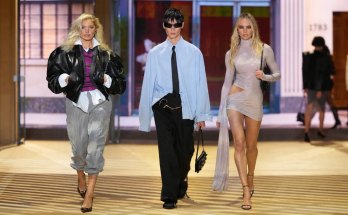
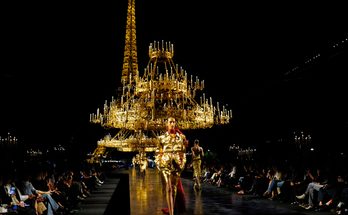
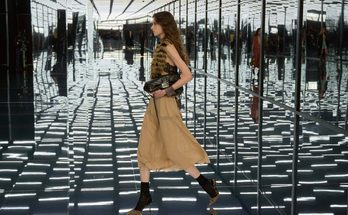
At sunset, in the heart of Rome’s ancient ruins, history met haute couture in a way the Eternal City had never seen before. Dolce & Gabbana’s latest Alta Moda collection unfolded along the Via Sacra, the oldest street of Ancient Rome, transforming the Roman Forum into a living, breathing runway—a spectacular celebration of classical antiquity and mid-century glamour.

This wasn’t just a fashion show—it was an immersive theatrical experience. Near the Basilica of Maxentius, guests took selfies with a modern-day Julius Caesar and a lyre player. Golden-hour sunlight bathed toga-clad performers lounging on the steps of the Temple of Antoninus and Faustina. Vestal virgins, armored centurions, and traveling actors moved through the central square, casting shadows against the Temple of Castor and Pollux as a buzzing audience of over 450 international clients, dressed to outshine one another, took their seats.
The collection paid tribute to both the timeless beauty of Roman antiquity and the bold exuberance of 1950s and ’60s Italian cinema—a blend that was, as one sharp-eyed guest noted, “more Satyricon than La Dolce Vita.”
A Roman Dream in Velvet and Gold

Domenico Dolce, seated in the front row during the show alongside Cher, Erling Haaland, Isabella Rossellini, and Christian Bale, took his solo bow in place of Stefano Gabbana, who was absent due to family matters. After twelve years of designing Alta Moda collections and staging shows in unforgettable Italian locales like Taormina, Venice, Naples, and Portofino, Dolce finally brought his vision to Rome. “These people,” he said after the show, “they have a vision of beauty.”
And that vision was evident from the first look: a deep red velvet cape worn over a strapless dress adorned with a sequined Capitoline wolf—Rome’s mythical symbol. What followed was a majestic procession of corseted gowns reminiscent of Roman emperors’ armor, molded in golden brass and paired with ethereal chiffon skirts. Stolas, the traditional Roman draped garments, were sculpted with padded torsos to create the marble-like folds seen in statues—breathtaking in their realism.
There were minimalist interpretations too: simple, vibrantly colored gowns cinched at the waist with engraved gold belts—one reading “Veni Vidi Vici”—and standout pieces in silk velvet, one a deep imperial purple, the other radiant gold.
Mid-Century Muses and Handcrafted Fantasy

Balancing the ancient references were silhouettes inspired by the golden age of Italian cinema: hourglass gowns with pleated fans and gauzy layers, impossibly light despite their intricate craftsmanship. These were fashion sculptures—thousands of hand-cut shreds of chiffon layered like mille-feuille, capturing movement and air.
Elizabeth Taylor’s Cleopatra echoed through braided chiffon capes in turquoise and orange, trailing behind like a whisper of old Hollywood. Elsewhere, black feathers, intricate beading, and motifs of marble busts and ancient coins brought the opulence of imperial Rome into dialogue with mid-century allure.
Rome: The Eternal Muse

Rome is a city built on layers—modern life perched atop ruins, past and present in constant conversation. Federico Fellini once mused, “Under the Rome of today lies ancient Rome. So close.” Dolce & Gabbana’s Alta Moda show made that proximity tangible. Among the many subtle references, a Coliseum-inspired dress stood out—both architectural and wearable, a masterclass in couture storytelling.

As the show ended, clients clamored to congratulate Dolce. Later at dinner, the designer offered candid reflections on today’s fashion industry—its reliance on formulas, its chase for coolness. “Sometimes fashion kills fashion,” he said. “Tonight, you saw what people really want: energy.”
Indeed, what unfolded at the Roman Forum wasn’t merely a fashion show. It was a declaration—a lush, exuberant reminder that in the face of homogeny, couture still has the power to transport. When in Rome, Dolce & Gabbana delivered a show worthy of emperors.