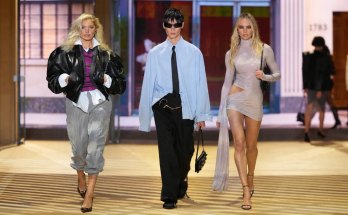
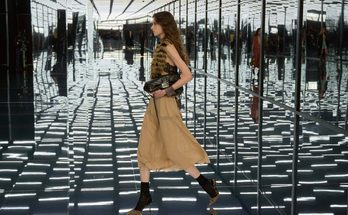
In the rarefied world of haute couture, where tradition often serves as both inspiration and limitation, Schiaparelli’s Fall/Winter 2026–2027 collection arrived as a bold declaration that true creativity can only flourish in uncertainty.

Titled The Call of the Void, Creative Director Daniel Roseberry’s latest couture offering embraced risk, contradiction, and experimentation, delivering one of the house’s most conceptually ambitious collections in recent memory.
Presented in Paris during Haute Couture Week, the collection continued Roseberry’s ongoing dialogue between surrealism and modernity, reinforcing Schiaparelli’s unique position as fashion’s great provocateur. Yet unlike previous seasons, which often celebrated spectacle and grandeur, this collection felt more introspective, philosophical, and emotionally charged.
The inspiration stemmed from the French expression l’appel du vide, a phrase describing the strange and fleeting impulse to leap into the unknown rather than retreat from it. It is a psychological phenomenon that many people experience: standing at the edge of a cliff and imagining the possibility of jumping, not out of desire for danger, but from an inexplicable curiosity about the void itself.
Roseberry transformed this unsettling yet fascinating idea into a meditation on the creative process. Following the acclaim of his previous couture collection, The Agony and the Ecstasy, the designer admitted that he briefly believed he had discovered the formula for success. Yet his attempt to replicate that success led him to an important realization: creativity resists formulas. Innovation cannot be manufactured through repetition or certainty; it requires surrendering control and venturing into unexplored territory.
This philosophy aligns perfectly with the legacy of Elsa Schiaparelli herself. The legendary designer built her house on surrealism, chance encounters, and artistic rebellion. Throughout her career she challenged conventions and collaborated with artists who questioned the boundaries between reality and fantasy. Roseberry’s latest work feels less like an homage to that heritage and more like a continuation of it.

The collection’s most radical statement came through its materials. Haute couture traditionally celebrates noble fabrics such as silk gazar, satin duchesse, velvet, and wool crepe. Roseberry instead introduced silicone, latex, and heat-treated layers of paint into the couture vocabulary, transforming industrial materials into objects of luxury and craftsmanship.
Rather than appearing cold or futuristic, these unconventional materials took on remarkably organic forms. Silicone corsets mimicked the softness and contours of skin, while latex tendrils appeared to grow organically from garments like living organisms. Layers of treated paint developed textures resembling shells, minerals, and coral formations found beneath the ocean’s surface.
One of the collection’s most memorable creations featured an ultra-realistic silicone corset painted in a soft milky blue shade. Paired with a dramatic skirt constructed from hundreds of flowers made from stretched hosiery, pearls, and wire, the look existed somewhere between sculpture and fashion. It captured the essence of Roseberry’s vision: garments that challenge our understanding of what clothing can be.
Elsewhere, natural flowers appeared alongside fish scales and fluid latex embellishments that seemed almost animated as models moved along the runway. The pieces evoked scenes from dreams or surrealist paintings, creating an atmosphere that felt simultaneously beautiful and unsettling.

The colour palette further reinforced this dialogue between nature and fantasy. Lobster pinks collided with luminous oranges and rich violets, while pale mint greens offered moments of softness amid glossy black surfaces and raw ecru textiles. The hues often felt aquatic, drawing inspiration from marine ecosystems and underwater landscapes.
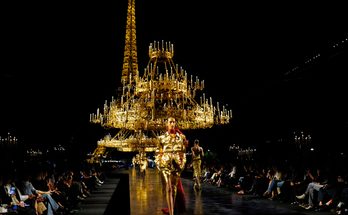
Gold, perhaps the most recognizable visual signature of modern Schiaparelli, remained central throughout the collection. Sculptural gold details adorned jackets, bodices, jewelry, and accessories, functioning less as decoration and more as architectural elements within the garments themselves.
Roseberry also revisited some of the house’s most recognizable codes. Schiaparelli’s iconic tailored jacket returned in new forms, elevated beyond traditional tailoring through elaborate embroidery and intricate embellishments. The garments became statements in themselves, blurring the line between fashion and decorative art.
Accessories continued the surrealist narrative. New versions of the Secret bag appeared embellished with crinoline-inspired structures and embroidered floral motifs, while the house’s Bubble shoe was reinvented with silicone coatings that introduced a futuristic sensibility. Jewelry designs referenced seashells, octopus tentacles, and sea anemones, extending the collection’s marine influences into wearable sculpture.

Beyond the craftsmanship and visual drama, however, The Call of the Void ultimately succeeds because of its intellectual ambition. Roseberry is not simply presenting beautiful garments; he is examining the relationship between creativity and uncertainty. In an era obsessed with algorithms, formulas, and predictable outcomes, the collection argues for intuition, experimentation, and the acceptance of failure as essential components of artistic progress.
Perhaps the collection’s most significant achievement lies in its redefinition of luxury itself. Silicone and latex are not used merely for shock value or provocation. Instead, they become tools through which couture can evolve beyond traditional expectations and explore new forms of beauty.
Not every look in the collection prioritizes wearability, nor should it. Schiaparelli has never existed to satisfy conventional taste or commercial expectations. The house has always sought to provoke, surprise, and challenge our understanding of fashion’s possibilities.
With The Call of the Void, Daniel Roseberry delivers not only a couture collection but an artistic manifesto. Through technical innovation, surrealist imagination, and fearless experimentation, he demonstrates that haute couture remains one of the few creative disciplines capable of venturing fearlessly into the unknown—and returning with something extraordinary.