Haute couture can be a make-or-break territory for designers. The discipline demands an extraordinary level of precision, patience and imagination, with every garment requiring countless hours of handwork and an obsessive attention to detail.

In a world where perfection can be measured in millimeters, not every designer is naturally suited to the pressure of creating clothes that exist at the absolute pinnacle of fashion.
Pierpaolo Piccioli, however, has always seemed perfectly at home there.
For his first haute couture collection at Balenciaga, the Italian designer returned to the territory where his creative instincts have long been at their strongest: dramatic silhouettes, extraordinary craftsmanship, expressive color and unapologetic glamour. The result was a collection that embraced the theatricality of couture while exploring what it means to dress in the present day.
Piccioli is no stranger to the demands of couture or to the expectations of fashion’s most discerning clients. During his time at Valentino, he became celebrated for creating collections that could inspire genuine emotion, presenting romantic and highly sophisticated clothes that frequently blurred the line between fashion and fantasy. His work attracted the attention of the world’s most influential stylists and transformed the runway into a stage for unforgettable red-carpet moments.
Now, at Balenciaga, Piccioli is entering a new chapter—one that connects his own creative history with the extraordinary legacy of Cristóbal Balenciaga.
The Spanish couturier has long been considered one of the most influential designers in fashion history. Christian Dior famously referred to him as “the master of us all,” a recognition of Balenciaga’s extraordinary technical ability and his revolutionary approach to silhouette. His work transformed the relationship between the body and clothing, introducing cocoon-like shapes, sculptural volumes and architectural constructions that continue to influence designers decades later.

For Piccioli, that legacy is particularly meaningful. Even during his years at Valentino, Balenciaga’s work frequently served as an important point of reference in his creative process. Now, those influences have found a new home.
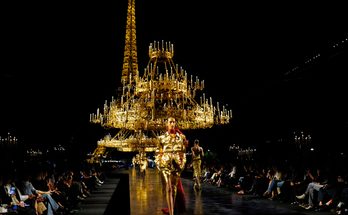
The collection was presented in the historic courtyard of La Cour d’Honneur de la Cité Internationale Universitaire de Paris, providing a suitably dramatic setting for Piccioli’s first couture statement at the house. The opening look, worn by model Anok Yai, immediately established the collection’s central idea: everyday dressing elevated to the level of couture.
At first glance, the outfit resembled a familiar combination of relaxed trousers, a simple white top and a bomber jacket. But nothing about the execution was ordinary. The trousers were crafted in voluminous beige silk, the white top expanded into a sculptural balloon-like shape, and the bomber jacket curved around the body in an exaggerated silhouette, completely covered in vibrant tangerine feathers.
It was an immediate demonstration of Piccioli’s ability to transform the familiar into something extraordinary.
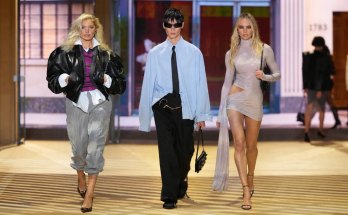
Throughout the collection, the designer continued to explore this tension between the everyday and the spectacular. There were certainly plenty of traditional couture fantasies: extravagant gowns embellished with feathers, watercolor-like sequins, delicate lace and luminous satin. Yet some of the most memorable looks emerged from unexpected combinations of high and low.
A couture-style white tank top appeared with sharply tailored black trousers. A voluminous white shirt was tucked into a dramatic violet feathered skirt. A classic black blazer was paired with a floor-length white blouse and trousers covered in delicate feathers that moved from the waist to the hem.

These combinations suggested that couture does not necessarily have to exist separately from real life. Instead, it can influence the way ordinary clothes are styled and understood.
A simple tank top can become something extraordinary when paired with opera gloves. A structured blazer can take on an entirely new character when worn over a grand ball gown. Even the most familiar wardrobe staples can feel transformed when approached with the confidence and imagination associated with couture.
This idea is particularly relevant for Balenciaga, a house whose history has always been rooted in challenging conventional ideas of elegance. Piccioli appears interested not only in recreating the grandeur of the past but in considering how that grandeur can speak to contemporary wardrobes.
The collection also revealed a careful dialogue between Piccioli’s own aesthetic and Balenciaga’s historical codes. The designer has long been known for his adventurous approach to color, often using vibrant and unexpected shades to create emotional impact. Cristóbal Balenciaga, by contrast, was renowned for his sophisticated use of black.
That contrast became visible throughout the collection, with repeated silhouettes appearing in darker, monochromatic versions. These all-black looks acted almost like shadows, creating a visual conversation between Piccioli’s modern sensibility and the house’s historical language.
The repetition of certain shapes was also significant. Rather than presenting every look as an entirely separate idea, Piccioli explored how a single silhouette could evolve through different fabrics, colors and treatments. The approach allowed the collection to feel cohesive while demonstrating the versatility of the designer’s vision.
Ultimately, the show felt less like an attempt to hide behind Balenciaga’s enormous legacy and more like a designer confidently stepping into it.

Piccioli understands that taking over one of fashion’s most legendary couture houses means acknowledging the past while refusing to be imprisoned by it. His debut suggests that he is prepared to engage directly with Balenciaga’s history, taking its most recognizable principles and reshaping them through his own creative vocabulary.
The result is couture that feels simultaneously historic and contemporary, extravagant and surprisingly relatable.
With Cristóbal Balenciaga’s legacy as a foundation and Piccioli’s own instinct for romance and spectacle at the forefront, the collection presents a compelling vision for the future of the house. It also raises an intriguing question: how will these couture ideas eventually filter down into the clothes that appear in stores and, ultimately, in our own wardrobes?
That transformation will become clearer as Piccioli’s next collections arrive. For now, however, the message is unmistakable.

This is a designer who understands the power of couture—and is not afraid to embrace it fully.
In a fashion landscape increasingly focused on commercial practicality, Piccioli’s debut is a reminder that there is still a place for excess, fantasy and clothes that exist simply to inspire awe. At Balenciaga, he has found the perfect stage for that vision.
And with pieces this extravagant, perhaps the clothes themselves are all the explanation we need.