The Spring/Summer 2027 menswear season has officially arrived, bringing fashion’s biggest names back to Milan and Paris for another round of runway spectacles.

This season unfolds against an unusual backdrop. World Cup excitement has taken over cities, Europe is facing soaring summer temperatures, and the industry itself continues to embrace a period of creative reinvention. Together, these elements have created an electric atmosphere that feels both energetic and unpredictable.
The calendar is filled with long-established luxury houses alongside exciting new creative chapters. Milan welcomed Simone Rocha’s long-awaited menswear debut, while Paris is preparing for Michael Rider’s first collection for Celine and Sarah Burton’s inaugural menswear presentation for Givenchy. Hermès continues its transition before Grace Wales Bonner assumes creative leadership next year, while Jonathan Anderson’s latest work for Dior has become one of the season’s most anticipated presentations.
If these early collections are any indication, Spring/Summer 2027 is shaping up to be a season defined by confidence rather than spectacle. Designers are moving away from unnecessary excess, focusing instead on refined tailoring, stronger silhouettes, and thoughtful storytelling.
From Prada’s embrace of slim proportions to Saint Laurent’s understated sophistication, Louis Vuitton’s surf-inspired luxury, and Dior’s playful reinterpretation of formal dressing, each collection offers a distinct perspective on where menswear is headed next.
With several major debuts still ahead in Paris, including new creative chapters at some of fashion’s biggest houses, Men’s Fashion Week SS27 is only just beginning. If the opening shows are anything to go by, the remainder of the season promises plenty more memorable moments.
Although the week is only getting started, several collections have already stood out for their vision, craftsmanship, and ability to redefine contemporary menswear. Here are our favorite shows so far.
Prada: The Return of the Skinny Silhouette

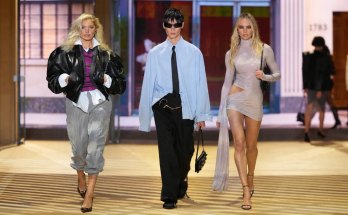
Prada once again proved why it remains one of fashion’s most influential voices. Designed by Miuccia Prada and Raf Simons, the SS27 collection embraced clarity instead of excess, offering a wardrobe built around precision and confidence rather than elaborate decoration.
The biggest takeaway was impossible to ignore: skinny silhouettes are making a strong comeback. Slim-cut denim, fitted T-shirts, narrow trousers, and cropped jackets dominated the runway, signaling a noticeable shift away from oversized proportions that have defined menswear for several seasons.
Rather than relying on dramatic embellishments, Prada elevated familiar wardrobe essentials. Crisp white denim, classic jean jackets, leather outerwear, and sharply tailored blazers were presented with impeccable construction, allowing each piece to stand on its own.
One of the show’s most memorable moments came at the very beginning. Model Julia Nobis opened the runway wearing fitted white denim paired with an oversized blazer and playful pigtails, immediately followed by her male counterpart dressed in black leather with the same hairstyle. It was a characteristically Prada gesture—subtle, provocative, and effortlessly cool.
Saint Laurent: The Art of Restraint

Anthony Vaccarello continued refining the unmistakable Saint Laurent aesthetic with a collection built around elegance through simplicity. Rather than overwhelming the audience with visual excess, SS27 celebrated the luxury of restraint.
The show’s notes referenced figures whose power came from what they chose not to reveal, including the fictional Mr. Ripley, whose carefully controlled image served as inspiration for the collection’s understated confidence.
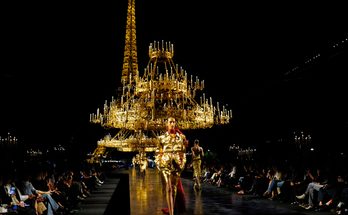
Models emerged through clouds of smoke wearing razor-sharp tailoring, slim trousers, shimmering gold trench coats, and brightly colored athletic-inspired blousons that injected fresh energy into the lineup. Vaccarello successfully balanced classic Parisian sophistication with subtle references to sportswear without compromising the house’s refined identity.
Accessories also played an important role. Sculptural footwear featured translucent materials reminiscent of the jelly-shoe trend currently popular in womenswear, reimagined as sophisticated evening footwear that complemented the clean silhouettes.
The result was a collection that demonstrated how restraint can often create a stronger impact than extravagance.
Louis Vuitton: Surf Culture Meets Modern Luxury

Pharrell Williams once again transformed the Louis Vuitton runway into an immersive experience, this time inspired by the freedom and optimism of surf culture.
Guests were welcomed by an enormous wave installation, immediately setting the tone for what Pharrell described as “the dandy experience.” Rather than presenting traditional beachwear, the collection explored how surf culture could intersect with refined tailoring and luxury craftsmanship.
Relaxed suiting appeared weathered by the elements, while wetsuit-inspired construction techniques blended seamlessly with sophisticated tailoring. Embroidered marine motifs, textured fabrics, and ocean-inspired embellishments reinforced the coastal narrative without feeling literal.
Streetwear influences also remained present through skate-inspired details and relaxed proportions that have become signatures of Pharrell’s creative direction. Yet everything felt elevated through exceptional materials and meticulous construction.
The collection successfully united two seemingly opposite worlds—the elegance of city dressing and the carefree spirit of the coastline—creating one of the season’s most visually engaging presentations.
Dior: Jonathan Anderson’s Playful Elegance

Jonathan Anderson continues to redefine Dior menswear with remarkable confidence. His latest collection felt like stepping into an exclusive house party where formal dress codes slowly dissolved into effortless morning-after sophistication.
The runway was filled with intentionally loosened ties, distressed denim, softly draped dressing gowns, and tailoring that appeared perfectly lived-in rather than rigidly polished. Anderson embraced imperfection, allowing garments to wrinkle, fray, and overlap in ways that felt spontaneous yet carefully considered.
His approach to character dressing remains one of his greatest strengths. Rather than simply presenting clothes, he creates personalities. Every model appeared to tell a different story, blurring the boundaries between elegance and ease.
Traditional French tailoring remained at the collection’s core, but Anderson infused it with humor, intimacy, and a sense of relaxed confidence that made the entire presentation feel refreshingly human.
The result was an imaginative balance between luxurious craftsmanship and everyday wearability—a combination that continues to distinguish his vision for the House.